
How Traffic Warrants Work in Scott County
An unpaid ticket does not turn into a warrant on its own, and knowing that spares a lot of needless worry. Minnesota traffic cases open with a notice to appear. Pay as directed, answer the notice, or show up on the listed date, and the case moves through the court with no warrant ever issued. Trouble starts when a required appearance is missed or a court obligation goes unmet. The judge can then issue a bench warrant, and the court can report the noncompliance to the state. Scott County District Court hears the traffic cases filed in the county. Minnesota runs one trial court statewide, so there is no separate city traffic court. City police write most of the tickets. The case that follows belongs to the court alone, and Scott County drivers deal with it there.
Scott County's Citation-to-Warrant Chain
Three Minnesota statutes lay out the sequence. Minn. Stat. 169.91 governs the notice to appear an officer hands a driver. Minn. Stat. 169.92 lets a court report a failure to appear or comply to the Commissioner of Public Safety. Minn. Stat. 171.16 covers the license notice and the suspension that can follow until the driver shows proof of compliance. That is why a Scott County driver may get a state license letter and a court notice about one ticket. They are two branches of the same problem, handled by two different agencies.
Note: A license hold is a state compliance step, and it is not proof by itself that an arrest warrant exists.
Scott County Traffic Warrant Checks
Every route in a Scott County warrant check is official. None of them is a driving record, so start with the paper the driver already has.
- Find the citation or case number, the court listed on the notice, and the response date.
- Search the case by number in Minnesota Court Records Online and read the case events.
- Call the sheriff's warrant unit at 952-496-8314 to ask whether a warrant is on file for that case.
- Call Scott County Court Administration at 952-496-8200 about the case, the hearing, or a copy.
- Call the city police records desk that wrote the ticket if the citation details are unclear.
- If the matter was filed elsewhere in Minnesota, contact that county, because Scott County confirms only its own warrants.
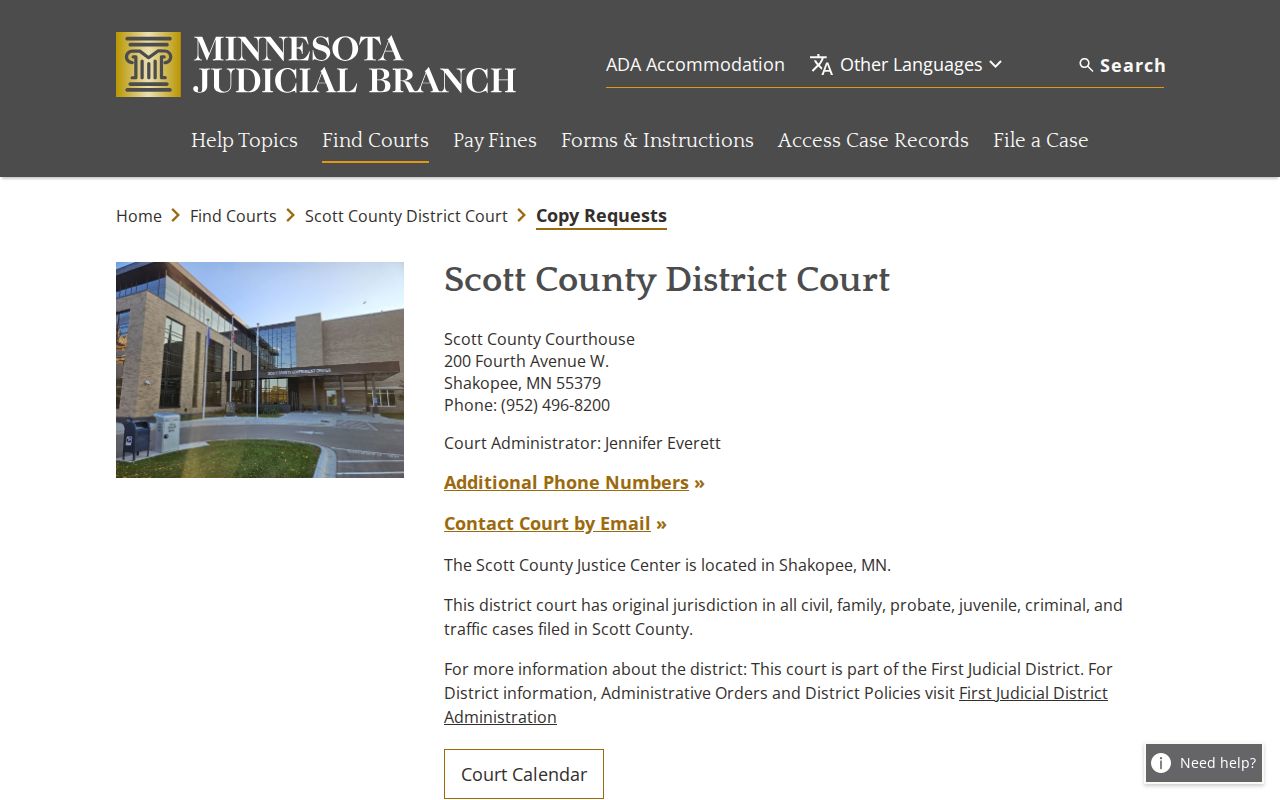
Scott County District Court hears the traffic cases filed here. Its copy request route opens the public case record a warrant check runs on.
Court records, not driving records, answer a traffic warrant question.
Scott County Warrant Dates and Payment
When a ticket can be paid without an appearance, Minnesota sends the money through the Court Payment Center. Savage's police page posts the details. The center answers at 1-800-657-3611 or 651-281-3219, and mailed payments go to the Minnesota Court Payment Center, P.O. Box 898, Willmar, MN 56201. Drivers are told to allow ten days from the citation before paying. The wait exists for a reason. The citation must be filed with the court before the payment system can see it, and paying into a system that lacks the ticket creates a mismatch that looks like noncompliance later. A Scott County driver should also check the notice itself. Payment is authorized only when the notice allows it. A citation marked for a mandatory appearance has to be answered in court, not with a check.
Traffic Warrants: What They Show
A traffic warrant is a court record tied to a citation. In Scott County, both the citation number and the case number matter when asking about one.
| Citation Number | The number printed on the ticket, or the case number on the citation |
|---|---|
| Case Number | The District Court file, which is the key the court searches by |
| Offense | The traffic offense, its statute, and whether it is a petty misdemeanor or higher |
| Issuing Court | Scott County District Court, or the court handling the case if it is elsewhere |
| Fine or Bond | The amount owed or the bond set, and the payment method the court authorizes |
| Status | Appearance due, failure to appear, warrant issued, compliance shown, or cleared |
| Compliance Notes | What the court needs before it reports compliance to the state |
Write the citation number down somewhere the driver can find it again.
Paying Scott County Does Not Clear a Warrant
The payment center moves money. A receipt alone lifts nothing. It does not confirm warrant status either, so the Scott County court still has to process the payment, update the case, and decide what else it needs.
Caution: Do not pay an amount blindly when the notice calls for a court appearance. Paying a citation that requires an appearance can leave the failure to appear in place while the money is spent.
Call the warrant line first. That one call tells a Scott County driver unsure about an appearance requirement whether payment is even the right next step.
Clearing a Scott County Traffic Warrant
Clearing a traffic warrant usually means giving the court what it asked for at the start. That might be an appearance, a payment with proof, a new hearing date, or a bond. The court order in the case controls the answer, not a general rule. So ask first. Court Administration can say whether the case needs a new date, a plea, or a compliance filing. The warrant line can say whether a Scott County warrant is open and whether bond is set. When a license action runs in parallel, ask what evidence the state needs before the suspension comes off. Remember one distinction. A paid fine and a cleared warrant are two different events, and a Scott County driver may need both.
The Scott County Traffic Warrant Rule
Minnesota handles a missed appearance on a petty misdemeanor in a specific way. Under Minn. Stat. 609.491, a person who skips the date can be treated as having pleaded guilty and waived the right to a hearing. The escape is narrow. The person must appear within the statutory period and show the failure was beyond their control. That ten-day window does not reach every traffic offense. Misdemeanor and gross-misdemeanor charges follow different rules. The case documents, not a rule of thumb, control which one applies to a Scott County driver.
Key Rule: Read the citation and any court notice for the exact deadline, because the petty-misdemeanor rule and the appearance requirements differ by offense level.
How Traffic Warrants Trigger License Holds
One missed date in Scott County can start two separate problems. The court reports the driver's noncompliance to the state, and the Department of Public Safety then issues its own suspension notice. Under the statute, that suspension holds until the driver files proof of compliance. So a driver can clear the traffic warrant and still have a suspended license, or satisfy the state while the court case stays open. Each side needs its own paperwork, and neither accepts the other's word for it. Hold on to the receipt, the case number, and any written confirmation from the court. Then check the license side on its own before assuming the whole mess is over.
Scott County Crime Maps and Traffic Warrants
Several Scott County cities publish a community crime map built from police incident data. Belle Plaine's map, for instance, plots selected incidents down to the block, with times attached, and leaves out categories like sexual offenses, domestic abuse, juvenile crimes, and civil paper service. Treat these maps as incident displays rather than court records. They carry no traffic warrant, hearing date, or payment status, and a person who never shows up on one has learned nothing about a case either way.
Note: Use the court case number for a warrant question, and treat the map as neighborhood information only.
Save Proof After a Scott County Warrant
The paperwork is the part people forget after a Scott County warrant is resolved, yet it is what settles the next problem.
- Save the citation, the case number, and any court notice.
- Keep the payment receipt with the date and the amount paid.
- Write down the new hearing date if one was set.
- Ask the court how the compliance will be reported to the state.
- Check the case record again a few days later to confirm the update landed.
A receipt proves payment in Scott County, but it does not prove that the court and the state have both processed it.